

Implementation of an integrated water resources management system based on artificial intellect DEEPBAS
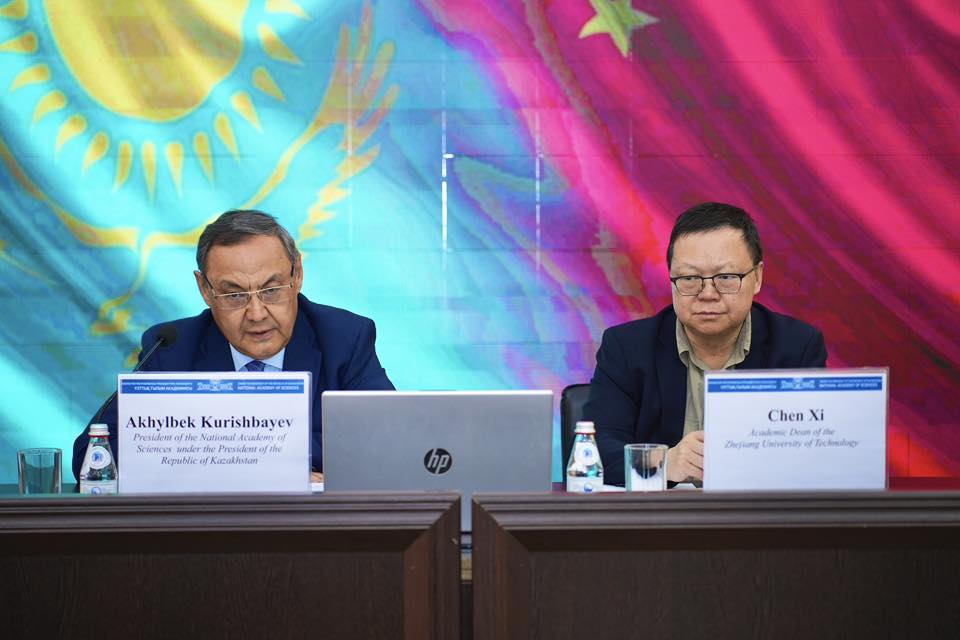
As part of the instruction of Prime Minister of Kazakhstan O.A. Bektenov on science development, on April 7, 2026, in Almaty, the National Academy of Sciences of the Republic of Kazakhstan under the President of the Republic of Kazakhstan (hereinafter referred to as the Academy), together with leading scientists from the Chinese Academy of Sciences and the Zhejiang University of Technology, held a meeting aimed at developing scientific and technological cooperation, implementing innovative solutions in the field of water resources, and sharing best practices.
In the face of increasing pressure on water resources and climate challenges, the implementation of intelligent management systems based on big data analysis and artificial intelligence is particularly relevant. The DeepBas (Deep Basin Spatiotemporal AI) project aims to take water resource management in Kazakhstan to a qualitatively new level of digitalization, efficiency, and evidence-based decision-making using artificial intelligence.
The event featured a presentation of modern smart water management technologies, including the Chinese-Kazakh spatiotemporal artificial intelligence model DeepBAS. This model is a spatiotemporal analysis system that can predict water balances and resource allocation, simulate water use scenarios taking climate change into account, improve the efficiency of water management systems, and support data-driven management decisions.
The event featured the following presentations:
- DeepBas and SHANG SHAN (Tuduo): a presentation of a spatiotemporal large-scale AI model and an integrated decision support platform.
- SIGMA: a laboratory presentation – a multifunctional mobile complex for a digital platform for monitoring and forecasting.
A.K. Kurishbayev noted in his speech: "The head of state explicitly identified water as a strategic resource and set the goal of transitioning to a modern water resources management system based on artificial intelligence. The government has set practical deadlines for the creation of a Unified Water Resources Platform and the launch of a National Water Resources Information System.
The situation in the water sector is critical. This isn't just a question of water scarcity, but also a combination of interconnected challenges: climate change, declining glacier resources, increasing runoff variability, more frequent droughts and floods, soil degradation, desertification, salinization of irrigated lands, deteriorating water quality, deteriorating infrastructure, water losses during transportation, a lack of reliable data, and limited forecasting tools. All of this requires not just the digitalization of individual processes, but the development of a scientifically sound, intelligent water resources management system.
It is crucial to emphasize that such a system cannot be built by mechanically transferring existing solutions. They require thorough scientific adaptation to Kazakhstan's conditions, taking into account the hydrological, hydrogeological, geographical, and geoecological characteristics, the transboundary nature of the basins, the water use structure, and public administration requirements. Therefore, specialized research institutes play a key role here.
Therefore, the goal of the meeting is to develop common approaches and jointly begin developing a scientific program that will serve as the scientific foundation for Kazakhstan's future water resources management system.
To date, the scientific and technical specifications for the flagship scientific and technical program "DeepBas Integrated Water Resources Management System Based on Artificial Intelligence" have already been developed. The next stage is the development of a comprehensive scientific program, including the development of the system's architecture, methodological approaches, and key research areas. Scientifically, the project envisions the integration of surface and groundwater data, climate and hydrological observations, land resource characteristics, and infrastructure into a single framework, followed by the creation of models, forecasting tools, and decision support, where artificial intelligence serves as a means of knowledge integration and enhanced analytics.
Since 2025, the Academy has established sustainable partnerships with Chinese scientific and technological organizations. As part of this collaboration, the Kazakhstan-China International Joint Laboratory for Spatio-Temporal Artificial Intelligence and Sustainable Development was established with the participation of the Chinese Academy of Sciences, Zhejiang University of Technology, Kazakh National Agrarian Research University, and high-tech companies from the People's Republic of China. This creates additional opportunities for attracting advanced scientific and technological solutions, but with the obligatory scientific adaptation to Kazakhstan's conditions.
Our goal is to integrate data on surface and subsurface conditions into a single framework.