
Kazakhstan is transitioning to water resource management using artificial intelligence (DIEPBAS).
In accordance with the instructions of Prime Minister of Kazakhstan O.A. Bektenov on the development of science, on April 8, 2026, in Almaty, the National Academy of Sciences of the Republic of Kazakhstan under the President of the Republic of Kazakhstan, together with scientists from the Chinese Academy of Sciences and the Zhejiang University of Technology, held a meeting aimed at developing scientific and technological cooperation, implementing innovative solutions in the field of water resources, and sharing best practices.
In the face of climate change, increasing water shortages, cross-border dependence, transportation losses, and the need for more accurate accounting and forecasting, the importance of scientifically sound digital solutions capable of integrating data, models, and management decision support mechanisms into a single framework is growing.
The discussion focused on the flagship scientific and technical program "DeepBas," which envisages the creation of a domestic decision support platform using spatiotemporal artificial intelligence, digital twins, mechanistic models, monitoring systems, and scenario analytics. The Irtysh, Ili-Balkhash, and Shu-Talas basins are being considered as pilot projects.
The meeting was attended by international partners of the National Academy of Sciences of the Republic of Kazakhstan, including representatives of the Chinese Academy of Sciences, Zhejiang University of Technology, and high-tech Chinese companies, including Tudou Data (i-Tudou). Approaches to building an intelligent water resources management system, developing scientific and technological cooperation, and developing a long-term research and personnel base were discussed.
Key topics of the meeting:
- The DeepBas project as the foundation of a domestic intelligent water resources management system;
- Digital twins, monitoring and predictive modeling of floods, droughts, and water losses;
- Interdepartmental data exchange and integration of hydrological, hydrogeological, meteorological, satellite, and operational information;
- International experience and opportunities for scientific adaptation of advanced architectural solutions in the field of water AI;
- joint research, knowledge transfer, and specialist training to develop national competencies.
To date, the scientific and technical specifications for the flagship scientific and technical program "DeepBas Integrated Water Resources Management System Based on Artificial Intelligence" have been developed. The next stage is the development of a comprehensive scientific program, including the development of the system architecture and methodological approaches.
The implementation of the DeepBAS project will be an important step in developing Kazakhstan's scientific and technological potential and introducing advanced digital solutions to the water management sector.
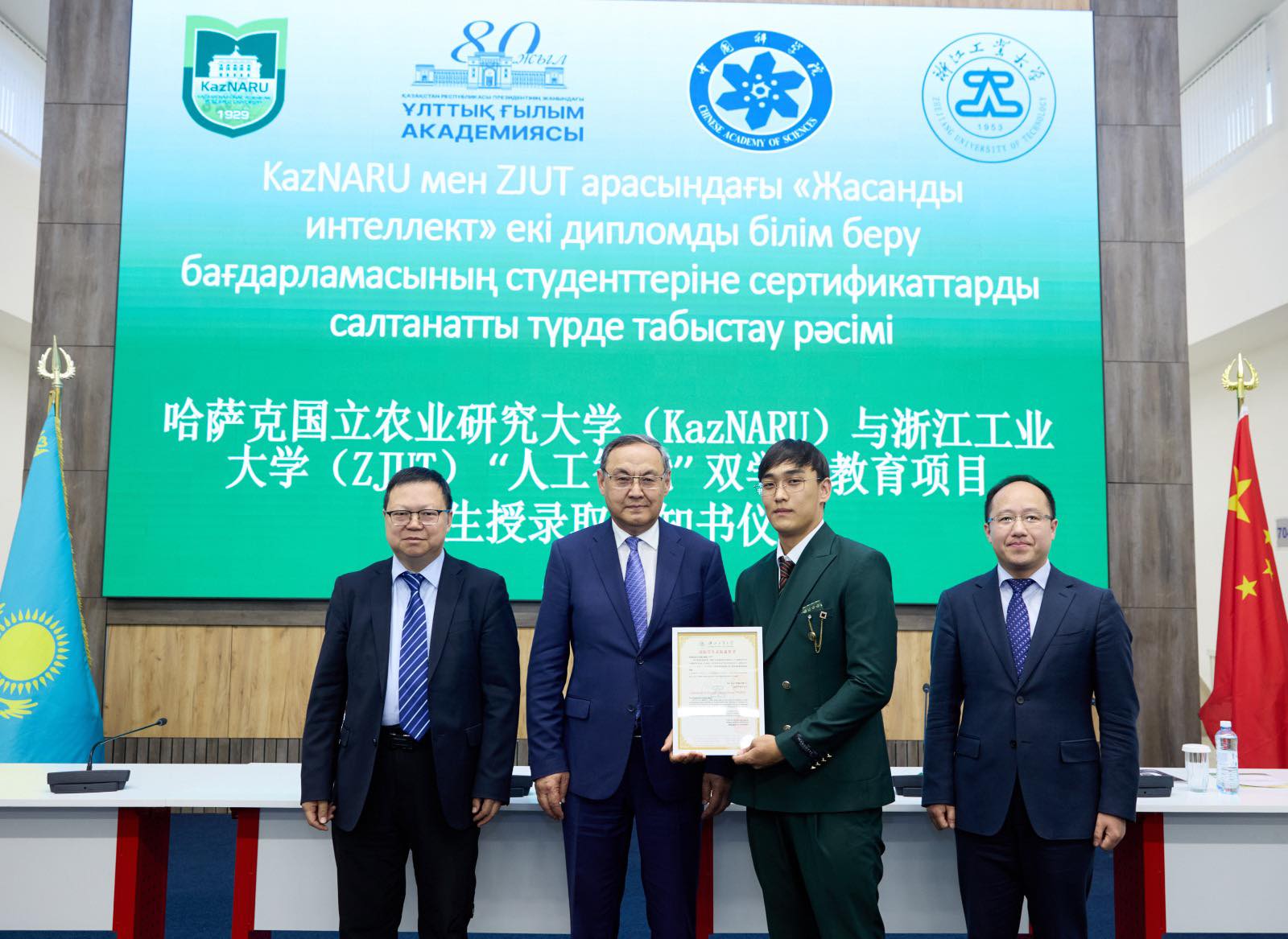
A significant educational event was also held – a certificate presentation ceremony for students of the dual-degree program "Artificial Intelligence," implemented jointly with the Zhejiang University of Technology. The event, held under the concept "Path to the Future: The AI Era," reflected the strategic focus on training a new generation of specialists capable of working at the intersection of science, digital technology, and industrial economics.
During the event, Akhylbek Kurishbayev noted that the development of artificial intelligence and international educational programs is a key factor in creating a competitive scientific and educational environment and the country's technological independence.
An additional outcome was the signing of a memorandum on the implementation of a dual-degree educational program in robotics, which expands the range of joint initiatives and strengthens integration into the international academic community.
The event was attended by the President of the National Academy of Sciences of the Republic of Kazakhstan, scientists from the Zhejiang University of Technology, representatives of major Chinese organizations in the fields of AI and water security, and scientists from Kazakhstan and China.
Following the meetings, a resolution was developed and a plan for further cooperation was agreed upon, aimed at developing joint research, implementing innovative solutions, and strengthening international scientific cooperation.